
Voting for the ‘Undiscovered Country’?

Today, over 14 million Lankan voters get to elect a new government. They can also pick from among 7,620 candidates vying for 225 seats in the national legislature.

The election campaigns for the past many weeks have seen the usual glut of rhetoric and promises. Our endlessly bickering political parties rarely agree on anything, so it’s refreshing to see a broad consensus on what this election is fundamentally about: future prosperity.

That’s no coincidence. This is the first time we elect our law makers since the long drawn and brutal civil war ended in May 2009. We have been looking back – or nervously looking around — for much of the past three decades. It’s about time we finally looked forward.

How we wish Sir Arthur C Clarke was still with us at this crucial juncture in our history! For half a century up to his death in March 2008, the author, explorer and visionary was Sri Lanka’s amiable ‘tour guide’ to that ‘Undiscovered Country’ called the Future.

Whoever wins this week’s election, shaping a better future will need clarity of purpose, hard work and persistence. Those looking for long term vision can start with the substantial volume of essays, interviews and speeches that Clarke has left behind. These form a veritable treasure trove of practical and pragmatic advice from the man who, during his illustrious career, commanded respect in both the White House and the Kremlin — as well as in Hollywood, Silicon Valley and other global centres of hard or soft power.

Clarke often said that there was an infinite array of possible futures: our actions (and inaction) determine which one becomes real. We create our own futures through our choices at individual, family and national levels.

“Despite all claims to the contrary, no one can predict the future,” he used to say. “I have always resisted all attempts to label me a ‘prophet.’ I prefer the term ‘extrapolator’.”
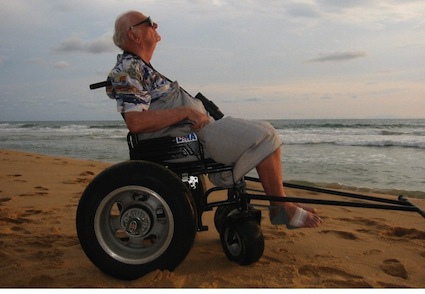
Sir Arthur Clarke – Feet on Lankan soil, gaze on the future…

Clarke was no armchair soothsayer — he had vivid imagination, but also knew the limits of crystal ball gazing. “What I have tried to do, at least in my non-fiction, is to outline possible ‘futures’ — at the same time pointing out that totally unexpected inventions or events can make any forecasts absurd after a very few years…”

While imagining scenarios for humanity’s evolution and place in the cosmos, Clarke took a special interest in Sri Lanka’s near-future prospects. For half a century, he remained a ‘critical cheer-leader’ for the island nation’s march to progress.

As he summed up in 2005, “During the time I lived here, I have seen my adopted homeland advance in various ways, but sometimes it has also taken wrong turns. If we have the humility to learn from past mistakes, the next half century can be far better than the last.”
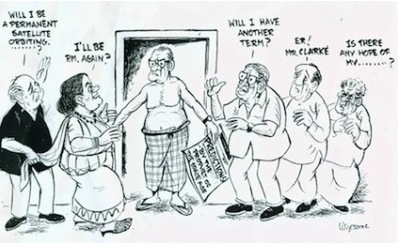
Cartoon
This cartoon by W R Wijesoma appeared in ‘The Observer’ newspaper in late 1960s. It shows leading politicians of the day seeking Clarke’s predictions for their futures!

Managing Diversity

Clarke’s guidance for Sri Lanka’s future development touched on many aspects, such as improving the quality of education, expanding coverage of telecom services and diversifying the mix of energy sources. As a diver, he also advocated conserving the coastal and marine environments.

He placed much value on investing in people. Having achieved impressive feats in health and education, he said, Sri Lanka’s next step was “not so much to add years to life, but to add life to years“. Future economic growth would have meaning only if it was socially and environmentally sound — and if the benefits were shared more equitably, he said.

But Clarke’s vision for his island home stretched beyond simply raising the Gross National Product (GNP) or building infrastructure. Adept at relating the micro with macro, he foresaw emerging trends ahead of many. He also tried to prevent undesirable futures from happening.

For example, he watched with concern how Sri Lanka’s population more than doubled in two generations since independence. He was an unhappy witness to the once idyllic island being torn apart by ethnic strife and ultra-nationalism. Managing human numbers and human diversity was among the biggest challenges he identified for Sri Lanka in the 21st Century.

In the last two decades of his life, he repeatedly called for greater tolerance and harmony among the various ethnic and religious groups all of who call Sri Lanka their home. He cautioned: “We should not allow the primitive forces of territoriality and aggression to rule our minds and shape our actions. If we do, all our material progress and economic growth will amount to nothing.”

He chose strategic moments to renew his plea for a peaceful end to the Lankan war, such as the golden jubilee of political independence (1998) and the aftermath of the Asian tsunami (2004).

Clarke never gave up hope, even when conditions looked particularly bleak. In a short video message released in December 2007 to mark his 90th birthday, Clarke listed ‘lasting peace in Sri Lanka’ as one of his three last wishes in life. Alas, he never lived to see any of them come true.

Some of the best brains on the planet are currently working on his other two wishes — detecting signs of alien life, and developing clean energy sources. Meanwhile, we Lankans must now consolidate the hard-won peace while healing the wounds of war.

Clarke’s vision can still guide us in this daunting task. Here’s a typical gem: “I’m optimistic that the land that has shown tremendous resilience over the centuries, and practiced a rare type of tolerance, could still return to normalcy –- although we should ensure that grounds for conflict are eliminated forever.”

That’s easier said than done. But if Clarke were alive, he would tell us that the alternative is far worse. Voting for the Undiscovered Country is only the first step in a long journey.

Science writer Nalaka Gunawardene worked with Sir Arthur Clarke for 21 years (1987 – 2008) as his research assistant, and blogs on media and society at: http://movingimages.wordpress.com

Print this post

3,313 views

9 Comments

  1. I’m a big fan of Arthur C. Clarke and enjoyed this article. Of course since you invoked the sayings of a white, non-Sinhala Buddhist in providing guidance for our resplendent isle I give it a few hours until the usual nationalist nutters and INGO/NGO conspirators start raining abuse on your head saying that you should be promoting those paragons of virtue instead Mervyn and Duminda.

    But really, irony apart, nice article:)

  2. what do you mean “voting for the undiscovered country?” Are you another sinhala tiger? The country of sri lanka has existed for centuries, and the people today have voted all of sri lanka in a DISCOVERED COUNTRY! get your facts straight, you big fat ape!

  3. The undiscoery of country started in 1948. Since then the islanders have been unable to discover the undiscovered country of Tamil Eelam (TE).

    Untill that is done and freedoms established jointly by TE and SL there can be no peace, hope and a future.

  4. Help! This is another western-funded, UN-sanctioned, Vatican-blessed, CIA-backed international conspiracy to destabilize Sri Lanka! Baba is right: Sri Lanka has existed for a very long time and it was one of the earliest countries to be discovered in the world. Archeological records show human settlements in this island going back to over 50,000 years. By denying this glorious civilization, the writer is trying to discredit it. Undiscovered indeed!

  5. ‘Undiscovered Country’ is a poetic phrase with a literal meaning. The original use was by Shakespeare in Hamlet.

    To the melancholic Hamlet, death was an undiscovered country. (See exact quote at http://www.monologuearchive.com/s/shakespeare_001.html). In Shakespeare’s most famous soliloquy, the Prince of Denmark hesitates in his consideration of suicide not because of an absolute Christian belief in divine retribution, but because he is afraid of an afterlife of which he cannot be sure.

    For the more cheerful among us, the Future is the great Undiscovered Country. Again, it is used poetically, not politically — and I think it’s important to note the difference (which some of our readers commenting above have missed). ‘Undiscovered Country’ has also been in popular culture in recent years, as I have just referred to on my blog – see: http://movingimages.wordpress.com/2010/04/08/sri-lanka-general-election-2010-voting-for-the-undiscovered-country/

  6. He was truly a “star gazer”, at least 50 years ahead of his time.

  7. If we want to create a technological future for Sri Lanka, we need to have highly educated, dynamic young people like Thilanga Sumathipala to lead the next team that will rebuild the nation!

  8. There is convincing “totalitarianism under the cover of democracy” in Sri Lanka(SL).

    Obviously, the Tamil nation in the North-East of the island, seeking independence for their homeland Tamil Eelam(TE), facing colonial occupation, brutal repression, human rights violations, disappearances and Tamil genocide, by about 80 percent, have boycotted and clearly rejected the election conducted by the colonists.

    The Tamils of TE have thus expressed solidarity with the Tamils in exile in Norway, France, Switzerland, Netherlands, Britain, Germany and Italy and other countries for the independence of TE.

    On the other hand in the Sinhala nation, except the cronies of both wretched major parties, the others believe that there is no purpose whatsoever in casting their votes.

    most of the past 60 years were ruled under emergency laws and even the present election was held under emergency in the country.

    The Sinhalese appear to believe firmly that by locking up Sarath Fonseka, using state vehicles for election propaganda, voter threat and intimidation, disenfranchisement, bribery and rigging; the wretched government of Mahinda Rajapakse will some how or other win. So about 50 percent of them did not vote.

    In democratic countries, the president asks his citizens to vote to express their choice.

    But, Rajapakse made the most undemocratic act by asking the voters not to waste their vote by voting for the opposition.

    Is SL going to be another Kyrgystan?

  9. Sir Arthur C Clarke was the great ‘extrapolator’ as we all know. I was in Sri Lanka just beofre the military push to the north that ended this conflict. It was a trubulant time and a scary time. We had been surrounded (our taxi) more than once with armed soldiers…who were not pointing their guns down to the ground. Now is a new era of hope. Nalaka my friend, the world is watching what happens there….and I just wish Sir Arthur was here to see the events unfold.

    David Damario
    Canada

Leave a Reply

This is a moderated forum. Comments are the sole responsibility of the person posting them. Please do not post comments that are off topic, defamatory, abusive, threatening or an invasion of privacy. Comments are automatically scanned for spam and obscenity.

Comments are only approved if they are in line with the site guidelines. Those that do not will be edited or deleted without prior intimation. Comment approval may take up to 24 hours.

Thanks in advance for your civil and constructive engagement.

Spam protection by WP Captcha-Free

About Groundviews

Located at the Centre for Policy Alternatives in Colombo, Sri Lanka, Groundviews is a citizen journalism website that uses a range of genres and media to highlight critical perspectives on governance, reconciliation, human rights, the arts and literature, democracy and other issues. The site has won two international awards, including the prestigious Manthan Award South Asia in 2009. The grand jury's evaluation of the site noted, "What no media dares to report, Groundviews publicly exposes. It's a new age media for a new Sri Lanka... Free media at it's very best!"

cezarneaga.eu
canakkale canakkale canakkale balik tutma search canakkale vergi mevzuati bagimsiz denetim vergi mevzuati ozurlu engelliler