
It is a hostage crisis, stupid!

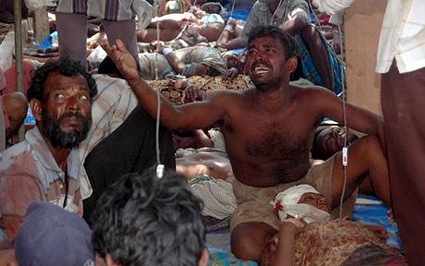
Injured civilians are seen in a make-shift hospital in this photo released by the pro-Tamil Tiger group

Image courtesy The Telegraph

The Sri Lankan military is dealing with probably the largest hostage crisis in world history. Sri Lanka and its present leadership will be forever remembered for how it handles this unprecedented predicament.

As a long and protracted battle draws to a miserable end, it is right to be intensely concerned about the civilian population trapped between the advancing Sri Lankan military and the cornered LTTE. It is easy to believe conservative reports that put civilians killed at an average of 35 to 45 a day – more than 4,000 since the beginning of the year – with a great many more severely injured. This is by all accounts an enormous tragedy. Recall that the 9-11 attacks in the US, which has become a focal point of history, killed less than 4,000 people. Sri Lankan lives should not be considered any less important.

Understanding the Crisis
There have been many divergent arguments made over many months about how the Sri Lankan government should view this crisis and act in the midst of it.

For instance, by demanding “Get your humanitarian paws off my country” Dayan Jayatilleka argues for the government’s sovereignty of choice over all else. Several international leaders have asked for a ceasefire as the all important first step. Michael Roberts has argued for a hardnosed utilitarian response, allowing the civilians here and now to be expendable for the sake of the greater and longer term reduction of death and suffering in the country. Human Rights Watch and similar groups have argued for following Geneva conventions and rules applicable to international warfare.

Each of the above arguments has some merit, but they all have the wrong focus. The current situation, as emphasized in a letter I supported in February, should in fact be understood as an internal hostage crisis – the trapped civilians are being forcibly held by the LTTE, as a bargaining chip against the military advance.

Analysts such as Dayan Jayatilleka seem to have grasped this fact significantly, yet manage, unfortunately, to focus concern on an abstract nationalistic ego rather than on individual human lives. Demanding a ceasefire – as done by some international leaders – does not automatically imply an understanding of the crisis either; sometimes hostages are better served by surgical military action. It is important to agree on the diagnosis, before arguing about the cure. The Sri Lankan military is and has been dealing with a hostage crisis.

Recognising the complexity
Each hostage crisis has to be dealt with according to its peculiar circumstances and the mindset of the hostage takers. The way to resolve a hostage crisis is to deploy the understanding you have of the hostage takers, together with your tactical capabilities, keeping firmly in focus the goal of saving every single hostage that you possibly can. Succumbing to the demands of the hostage takers is usually a last resort – but one that should be considered for the sake of the hostages.

This particular hostage crisis is acutely complicated for several reasons.  First, it might be the largest hostage crisis in world history. Second, the hostages may be uncertain and fearful of how they will be received by the “other side”. Third, the hostages may be subject to forced recruitment, compromising their safety even in a “ceasefire”. But there is no denying the fact that these trapped people are being held forcibly against their will and are indeed hostages.

It is extremely unpleasant when a militia is able to negotiate undeserved terms for themselves on the basis of holding hostages that it has no compunction about killing. But that is precisely the reason hostages are taken, because monstrous militants are able to exploit the inherent humanity of elected governments to force concessions – exploiting the collective social concern for those people who have been taken hostage.

If Sri Lanka is to rise above being a racist nation, then the collective concern shown now for these hostages must not depend on their ethnicity. Would the current methods in dealing with this crisis be the same and have the same support if the hostages were Sinhala Villages?

Responding with humanity
The Sri Lankan government is enjoining people to wait with anticipation and baited breath its military victory over the LTTE. But in a hostage crisis, the capturing or death of the hostage takers is less important than the safe rescue of the hostages.

Governments that prioritise capturing the militants over concern for hostages only mirror the monstrous instincts of hostage takers and surrender the natural respect due to them as representative democratic regimes. This happened in global view in the manner that Russian forces dealt with the Beslan school hostage crisis in 2004, and Sri Lanka too has been sadly following that route in the last few months.

The need of the hour is not to pander to the jingoist calls for destroying the LTTE – as reflected in government statements.  It is not to worry about the “image” of Sri Lanka in the international community – as suggested by political strategists and pundits.  It is not to adopt the inadequate requirements of Geneva conventions and the laws of war – as asked for by Human Rights advocates.  And it is certainly not to throw a life-line to the LTTE – as being cynically attempted by large scale protests organised by Diaspora Tamil groups.

It is a hostage crisis, and the need of the hour is to stay focused on rescuing the hostages, with the least harm inflicted on them as possible. Already, too many lives have been lost, and it is all the more important to recover the necessary focus as soon as possible.

This particular hostage taking act of the LTTE is diabolical and repugnant. But each of us becomes smaller and meaner when we allow that to engender in us support for a response which is equally revolting. To avoid becoming what the LTTE has become, it is necessary to remain focused on the goal of saving as many of those hostages as possible. That must be the goal around which our collective imagination and ingenuity is deployed at this pivotal time in Sri Lankan and world history. To do less is to surrender our humanity.

Print This Post Print This Post

5,613 views

24 Comments

  1. “Governments that prioritise capturing the militants over concern for hostages only mirror the monstrous instincts of hostage takers and surrender the natural respect due to them as representative democratic regimes”

    On the spot. Very well said.

  2. LTTE terrorists
    It’s a matter of time that LTTE terrorists will be defeated by the forces. Time is running out for the terrorists. What is astonishing is that the Canadian and UK Tamil Diasporas who are supporting the LTTE terrorists are not demanding from LTTE to release the innocent civilians. They also can’t understand that no single government has taken a stern action against the SL Government for fighting against the terrorists except for announcing from time to time “We urge both parties to have a ceasefire” The underline, unspoken message to the world by these governments are “we can’t wait until you finish the terrorists” Don’t the Canadian and UK Tamil Diasporas get the message! Losers normally can’t understand and they don’t get it.

  3. Well focussed on the pertinent issue Nishan. However, can the military response afford to leave room for the ‘Hostage takers’ to escape, to reenact the same drama once again? I do not claim to know the answer to that question, but what i do know is that, our “understanding [] of the hostage takers” this is a key issue that have to be considered.
    Perhaps the tone of our rhetoric and the intentions that drive our actions have to be checked more diligently and honestly now more than ever before, because the way this “war” “ends” will inspire a great deal of what happens in the aftermath.

  4. Rebelling guns of 30 yrs and not repressive institutions of 60 yrs come under ”terrorism” ?

  5. The write-up deserves serious consideration – it is a shame and a tragedy that 28 years after Virginia Leary wrote that ”The fate of the Tamils in Sri Lanka remains a matter of international concern”, we’re in this state.

    1.In 2004/5 I met a lot of people in Kilinochchi from various vertical and horizontal levels who have been driven around the North in the 80s and 90s by aerial bombing. Some of them are very likely to be still there in the Vanni beach under fire and some others in the ”holding camps”.
    2.Judging by the reports of fact-finding missions to the Northeast in the last 30 months, all the people in the Northeast are, in a way, hosatages.

  6. im a bit confused about these casualty figures, can some body tell me how these people differentiate between civilian casualties and combat casualties. there is credible information that ltte is forcing people to fight in the front line, young and old , so in that case how these people came to the conclusion that they r not combat casualties and if they can differentiate the two clearly then thye should have the casualty figures of ltte carders as well, so y dont they let them out as well?

  7. Yes it is a hostage crisis, albeit writ very large. Does anyone recall the UK’s response to the Iranian embassy hostage crisis of 1980? I think it was the right one, for the right reasons, and ours should be the same on an appropriately larger scale.

  8. How about the number of civilains killed in Iraq. Over 1 million.
    Probably Iraqi lives are less important for the US and UK

  9. If SL army kills 200 per day, The Tamils would have vanished from Sri Lanka a years ago. Please do not listen to these LTTE AND TAMIL DIASPORA. This is false propaganda against Singhalese people and peace loving people of Sri Lanka. There are about 65% Tamils people lives with sinhalese people in the South of Sri Lanka. They live very good life others. Yes Sri Lankan killed LTTE terrorists not civillians. LTTE had about 10-15 thousands terrorists now left only 400-500 only. They should surrender or let civillians to leave. Then they can fight to death with the army. Come on they are TAMIL LIBERATORS /HEROES… please asked them not to hide behind civillians and ASK them to fight face face with the LIONS. Then the peace will come to Sri Lanka. ALL THE DIASPORA WELCOME.

  10. We seem to be in danger of buying into the propaganda of this “hostage crisis” and “rescue mission,” when in reality this is a military operation to eliminate the LTTE (which is a laudable goal, but let’s call it what it is).

  11. If Sri Lankan Army Kills 200 per day .. they would have finished all the Tamils from the Island long times ago. These news are Tamil Diaspora’s false accusation against Sri Lanka.LTTE PROPAGANDA . Please think twice about these things before you decide.
    Never had a tamil Kingdom in the North Of Sri Lanka in the history of Sri Lanka. They cannot rewrite the Sri Lankan History. Yes they had in TAMIL NADU (CHOLA ), NOT IN SRI LANKA. SLArmy kills LTTE terrorists, not the civillians. They selects the targets very carefully (terrorist bunkers with Art/Guns etc) and uses heli.gunships to destroy them. That’s how they saved all these 200thousands innocent civillians. The civillians tell their true story… please listen to them. They tell you, how they suffered in that LTTE area. If LTTE cadres are Heroes of tamil people, we need to see the proof.. please come out and fight like real heroes.. do not hide behind tamil civillians. Let the civillians go.They suffered enogh all these times. You are enemy of your own race. What a SHAME.

  12. TAMIL TIGER TERRORIST BECOME A CIVILLIAN WHEN HE DIED IN THE BATTLE. WHAT HAPPENED TO THE 15000 TERRORIST FIGHTERS…. ?????? WHY THEY LEFT WITH 400-500 FIGHTERS NOW ..???
    THEY ARE THE CIVILLIANS WHO DIED IN THE WAR ZONE OF SRI LANKA.

  13. Excellent analysis. I had hoped that this was in fact what the government was doing. It has considerably slowed down precisely because of the hostages. It has rescued 120,000 sustaining casualties on its side. At the maximum 6500 civilians have lost their lives. I say maximum for this number is disputed and we don’t know how many of these were actually combattants. We would all prefer zero casualties in a hostage situation but in reality there are always casualties and given the number of hostages does anyone know how the number of casualties compare with other hostage situations.

  14. Most hostage takers have demands. These hostage takers have demands we cannot meet. Therefore you let the forces prevail. Anyway what part of we don’t negotiate with terrorists that people don’t understand? The least long term casualty figures will result in a decisive end to the terrorists now.

  15. I am afraid we are treating a very serious human issue very callously. Technically, terrorism is a tactic for waging war. What counts as terrorism is defined by traditional just war theory and not by what George Bush said or anybody else says. Just war theory says war is only justified when fought for just cause, minimally self-defense, as well as by just means. The latter includes rules of engagement, for instance proportionality, targeting combatants and
    not civilians, treatment of prisoners of war with compassion, etc. Terrorism, we are told, is barbaric because it intentionally targets civilians, so it fails the just means test. But fighting terrorists also comes within the just war theory.
    IIn World War II, for instance, the just war against German and Japanese aggression turned into an unjust war when the United State and its allies intentionally targeted German and Japanese civilians in the fire bombings of Hamburg, Dresden, Tokyo, and other cities, as well as the atomic bombings of Hiroshima and Nagasaki. The Americans have no doubt violated the just war rules which are embodied in the Geneva Conventions. But pointing them out will not excuse us from violating these rules.
    Indeed, the technology of warfare today is so enormously destructive that more civilians regularly die in conflicts than combatants, as is the case in Iraq and Afghanistan today, In spite of euphemistically named directed targets there is little doubt that civilians would have been killed in air strikes” despite giving credit for best intentions. It is not just the United States that is culpable; it is every war everywhere in the world today. The logic of war always tends towards total war; win by whatever means necessary or perish. War is an ugly business and inevitably brings out the worst (as well as some of the best) character traits in humans. The logic of war and the technology of war almost always trump the just war theory, but it does not mean that we should abandon the discourse of just war, the Geneva Conventions, the prohibitions against child-soldiers, etc. What is actually going on in spite of our best efforts, should not blind us to these ideals nor make us overlook any violations of the Geneva Conventions, remembering the old adage that in war truth is the first casualty.
    What do we make of terrorism. Terrorism is a tactic in guerilla warfare. ,
    . This is not to justify such methods, but to point to the obvious, that terrorism is a tactic of the weak.
    If we want to end wars in the world today, or here in Sri Lanka, then we must understand that many of injustices, perceived and real, lie behind human conflicts. The powerful can enforce an unjust status quo. The powerless will always be tempted to use the tactics of terror to advance their causes and seek address to their grievances. It is more the obligation of the powerful to address the root causes of the injustices, than it is of the powerless to abstain from what they generally understand to be legitimate “self-defense”. Still I would argue that the oppressed and powerless would be much better served by nonviolence. And whatever side of a conflict one finds oneself, without an attempt to understand one’s enemies, it will not be possible to resolve these many conflicts.
    Whether we fight wars with so-called conventional means, or with unconventional means, war unleashes a social dynamic of terrible power. To motivate soldiers to kill and be killed requires an enormous amount of ideological and psychological indoctrination. We may have an innate instinct for aggression, but we also have an innate instinct for self-preservation.

  16. If The Underdog is challenging the *diagnosis* of the problem as a hostage crisis, then we do clearly differ. But can the govt “response” be described as one appropriate to a hostage crisis? My answer is likely the same as The Underdog.

    If DJ means the US response to the Iranian embassy hostage crisis of 1980, then details are available here: http://en.wikipedia.org/wiki/Iran_hostage_crisis the concern, patience and compromise then to rescue the hostages alive, was truly impressive.

    If other responses and finally Observer with “we don’t negotiate with terrorists” mean that the moral compass of SL is being set by the actions of George W. Bush as US President, then I think they are — perhaps unconsciously — making a devastating critique of SL society and govt.

  17. Should we consider those kept in the camps as hostages as well? Because they are clearly not allowed the psychological support they require to survive or at least maintain their sanity.

  18. Realist >>

    Very nicely put, and I agree with you a great deal, except for a few additional aspects in this situation.

    1. Terrorism may be a tactic of the weak, but it’s also a tactic of the unimaginative. Instead of defeating the strong idealogically, they choose to outdo the strong with a show of their own strength. I think the results are visible to all of us.

    2, , By using utterly despicable means and offering endless justifications for those crimes they have also completely stripped themselves of any supposed moral high ground.

    3. The LTTE believed itself to be stronger through its repeated rejection of peace-talks. It refused to make itself amenable to any reasonable solution. Again, the results are visible to all.

    4. It outdid the supposed racism of the govt. with a response which was a thousand-folds amplified, a response that has become increasingly disproportionate to the problem over time.

    Apart from that, yes, I would agree with you. A better analysis of the reasons/justification used by them is certainly necessary.

    What should concern us is not the existence of an LTTE ( should we be concerned about the existence of the American Nazi Party? ), but the reasons why a majority of Tamils felt compelled to start supporting the LTTE. I certainly hope those issues can/have been addressed. IMHO, the LTTE, on the other hand, is yet another racist outfit, insistent on creating a little racist utopia for themselves. They should and must burn in the hell they so justly deserve, so that reason and sanity can prevail and the real problems of the Tamil people can be addressed.

  19. As it is becoming clear that it is in fact a hostage crisis in Vanni, sadly a theatre like suspense is gripping most of us watching the scene. We are becoming hostages of a gripping drama waiting anxiously whether the siege will end with or without a bloodbath. The questions build tension. ‘Is Pirabhaharan still alive? Has he escaped? Will he commit suicide or will he die fighting? Any time now it may end and we must not miss the final scene!’ As the end nears, the tension rises. Commentators and chat show hosts are cashing in on the suspense and its tension. The danger of such a spectacle is that once it ends we will forget that it was a reality and therefore we may forget that the people were real too.

    A second but a related point is that by focusing on the hostage crisis if Vanni we have taken our attention away from several other hostage crisises of the country. This is the problem of intensely gripping spectacles. Let us not forget the hostages of the Sri Lankan Army in Vavunia who escaped LTTE. Let us also not forget the hostages of JVP and JHU – that is the Government- who have to perform in the theatre of Vanni. Sri Lankan Governments are a type of policy hostages. Let us think of ways to end the supremacist ideology, which held generations of Singhalese politicians as slave hostages.

    As for Pirapaharan he is a hostage to his own obligations to the Tamil People that he has taken upon himself to save them from Singhala domination.

    The whole country is in a hell of a hostage crisis, some of which are historical and some manage to hit the screen in a big way!

    One thing is clear, that the country is united in its fate to be hostages of its own making.

  20. @ Sair,

    A very good point. And can someone explain to me what would happen if one of those camp dwellers filed a fundamental rights petition saying (very rightly) that his/her right to freedom of movement has been impinged. The only way for the government to get around this is to arrest him/her under emergency regulations. In which case, they really would have to consider all of the refugees as under arrest.

  21. Thanks for a good analysis of the situation and what the response should be. A concerted effort to annihilate the LTTE has now turned into a hostage crisis. And very correctly, the primary concern in a hostage situation is the hostages. But must the current situation in Sri Lanka be defined (primarily) as a hostage situation for there to be ‘concern’ for its citizenry. What if there was little evidence to suggest that the LTTE was holding people hostage? Is there then an equal argument for the safety and concern of the people?

    As someone said, this is an outright effort to defeat the LTTE, and let’s call it that. But, if we are unable to ‘rescue’ those citizens trapped by the LTTE in a ruthless and selfish attempt to clutch at a last resort, then we will have failed by these people and all other people in this country. How we deal with the rescue effort will be a legacy we carry forward into the future…

  22. We seem to have lost our sense of humanity and humanism. In the nationalist ideology the “other” do not ahve any rights. They are not us. They are our enemies and don’t deserve any sympathy. So why bother. Of course Jesus Christ said ‘love yor enemies, do good to them that hate you” Buddha said that hatred is not extinguished by hatred but only by love. But religion in our country today has nothing to do with these teachings of the Great Teachers. Ours is a religion of sanctimonious hypocrisy. Just see how piously our politicians appear on TV carrying sacred objects of worship on their heads. But they are hypocrites. They never practise any moral values. Religion here is formalism, ceremonial and ritualistic. It is all hypocrisy to hoodwink others.

  23. To Observer:

    Most other hostage takers also have completely unreasonable demands, so the situation is not as dissimilar as you might suspect.

    The LTTE has clearly demonstrated that they intend to fight on to the last man/woman/child in their custody. In their moral and ideological calculus, their organisation is indivisible and inseparable from the Tamil people at large, and they take this to the extreme of viewing the lives of Tamil civilians, as with LTTE fighters, as expendable for the greater glory of the nation and the larger than life cause that they have assumed.

    If the govt also adopts the attitude that these civilians are expendable pawns, whose lives must (tragically) be sacrificed for the greater good under some perverse cost-benefit calculation, then there is very very little to morally distinguish the two sides.

    This desperate and gruelling standoff is a test of character and strength for everyone. It has the potential of becoming as much of a historical turning point, and as searing a moment in the consciousness of future generations as was July 1983. In my humble opinion, the LTTE has, in just the past 3 months, already done enough to discredit themselves irredeemably. By calling the attention of the whole world onto their self-inflicted calamity in the hope of invoking intervention, they have succeeded only in arousing widespread disgust at themselves, and in winning some grudging sympathy for the approach of the Sri Lankan government.

    The present stand-off has provided the Sri Lankan state, and the Sinhala majority community at large with an opening and a moral choice that, if approached with compassion, humanity and wisdom, will help to overcome the many injustices of the past. If instead, they do what Observer suggests, and take the easy path of finishing off the Tigers at the cost of the civilians, then they will be remembered for another generation, as the people who committed a terrible outrage and that participated in the deaths of thousands of innocents. It will be a case of snatching defeat from the jaws of victory.

  24. The situation has been worsened by the fact that the government has not allowed Independent reporters to be present at the war zone to ascertain the actual facts. Why? This is a clear indication of the fact that the government is hiding the ground situation from the world. On the other hand LTTE have called for Independent reporting.
    In effect two nations are at war in one country,. The fact that the peace accord has demarcated certain areas to be managed by the Tigers until a final solution is reached, has been violated by the government unilaterally.
    A question was asked by a girl in a recent interview over the BBC Tamil service thus:- If India and Pakistan is at war, and Pakistan have the upper hand, will India ask its civilian population to go into Pakistan to avoid being killed, thus enabling Pakistan to walk into India and destroy its army?
    The ideal way to ascertain facts is to allow independent observers to visit the war zone at their own risk and report.

Leave a Reply

This is a moderated forum. Comments are the sole responsibility of the person posting them. Please do not post comments that are off topic, defamatory, abusive, threatening or an invasion of privacy. Comments are automatically scanned for spam and obscenity.

Comments are only approved if they are in line with the site guidelines. Those that do not will be edited or deleted without prior intimation. Comment approval may take up to 24 hours.

Thanks in advance for your civil and constructive engagement.


two + 5 =

About Groundviews

Located at the Centre for Policy Alternatives in Colombo, Sri Lanka, Groundviews is a citizen journalism website that uses a range of genres and media to highlight critical perspectives on governance, reconciliation, human rights, the arts and literature, democracy and other issues. The site has won two international awards, including the prestigious Manthan Award South Asia in 2009. The grand jury's evaluation of the site noted, "What no media dares to report, Groundviews publicly exposes. It's a new age media for a new Sri Lanka... Free media at it's very best!"

cezarneaga.eu