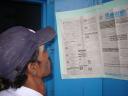
People Reading Newspaper At Shop In Jaffna
A person reading Uthayan newspaper publishing in Jaffna at a newspaper agent shop entrance. Newspaper printing has dropped due to publishers not having permission to send more news print paper from Colombo.
One agent pasted the newspaper in his shop entrance the customers come and read the newspaper in the early morning. He said he sold 450 copies earlier now the Uthayan company send only 60 copies.” I want to satisfy my customers so that I pasted the newspaper in my shop entrance,” he said.



From: http://www.rsf.org/article.php3?id_article=20666
Open letter to the donor countries’ ambassadors regarding the situation of the media in Jaffna
26 January 2007
Your Excellency,
We are writing to express our serious concern at the acute shortage of newsprint and printing ink in Jaffna and the implications this has on the ability of people in that region of Sri Lanka to access the news.
Reportedly there has been no road connection between Colombo and Jaffna since the main A9 road was closed last year due to heavy fighting. The commissioner for essential services has so far refused to load newsprint and ink onto the few ships carrying supplies to Jaffna.
This has resulted in severe hardships for newspapers in Jaffna. According to our reports, all three newspapers in the city now print only four pages and print runs have also been drastically reduced. For example, Uthayan, Jaffna’s best-selling paper, used to print 12 pages and sell about 20,000 copies, whereas it now prints only 7,500 copies of four pages and will reportedly soon have to reduce further to just two pages. Uthayan may have to close in about one month if it does not receive supplies of newsprint and ink.
We respectfully remind you that there are no radio or TV stations in Jaffna and the only way people in the region are able to get news is through newspapers.
As you will be aware, access to information is a key element in ensuring stability, and the lack thereof may lead to exaggerated rumour replacing accountable journalism as the main source of news for the local population, thereby fuelling instability and violence.
We respectfully call on you to do everything possible to enable the delivery of newsprint to Jaffna so that the city’s publications are able to carry out their vital activity of informing the public. In particular, we request that newsprint be included among the supplies carried into Jaffna.
We look forward to hearing from you at your earliest convenience.
Yours Sincerely, Members of the International Press Freedom and Freedom of Expression Mission to Sri Lanka
Those organisations associated with the International Mission include: ARTICLE 19 FreeVoice International Federation of Journalists (IFJ) International Media Support (IMS) International Press Institute (IPI) International News Safety Institute (INSI) Reporters Without Borders (RSF) South Asia Press Commission (SAPC) United Nations Educational, Scientific and Cultural Organization (UNESCO) World Association of Community Radio Broadcasters (AMARC) World Association of Newspapers (WAN) World Press Freedom Committee (WPFC)
I remember going to Uthayan in late 2002 or early 2003 with a group of senior Nepali journalists as part of a mission that at the time sought to inspire them on how media could play a role in fostering a ceasefire agreement and a resulting peace process. I guess the tables are turned today.
What struck me most of all the journalists we spoke to in the Peninsula was their resilience in the face of incredible hardships and threats to personal security by both the Army and the LTTE. Uthayan has a particularly interesting collection of newspapers printed on recycled paper and even cardboard, at times when in the past, the newsprint didn’t reach them.
That they face an even worse situation today is an indication of how, as David Blacker said elsewhere in this forum, the ceasefire agreement was unable to secure a peace process in Sri Lanka.
I just read Sunanda’s last short story here – http://www.groundviews.org/2007/02/02/notes-of-a-citizen-journalist/ – that’s an interesting perspective on what we journalists face in Jaffna daily. All media in Sri Lanka is under threat, but as journalists we haven’t been able, I feel, to communicate the problems we face when reporting and gathering news to the public.
After the closure of A9 and commercial sea routes, the authorities could only afford to send a limited amount of goods to Jaffna. LTTE has routinely refused entry to government aid convoys and it costs a lot of money to send them by air and sea. Therefore it’s natural that they cut down low priority items such as printing paper so that they could send more food and other essential goods. It doesn’t mean that there’s no newsprint available to Jaffna based papers. They are still printing thousands of newspapers everyday and people are still reading them in libraries, community centres and shops.